Visit for New Members to Gullet Quarry
Wednesday 30th November 2016
Field Trip led by Moira Jenkins
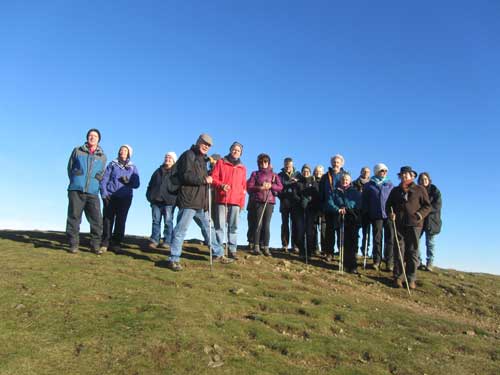
An ideal sunny day greeted us at Swinyard car park. Blue sky, not a cloud to be seen and no wind. The only draw-back was the cold! It was -6C° when 16 new members gathered today to start this visit.
Before setting off Moira gave us a brief introduction (too cold to stand still for long!) and showed us some examples of the main rock types to be seen in the area-
· a pinkish granite and a darker rock, diorite. These are the igneous rocks which form the main body of the Malvern Hills complex. These rocks are over 600 million years old and come from the Precambrian period.
· a greyish brown sandstone rock. This sedimentary rock was formed some 430-440 million years ago (“mya”) in the Silurian period and is mostly found immediately to the west of the Malvern complex rocks.
· a dark grey rock speckled with shiny chips of quartz. This is a conglomerate formed around 500 mya in the Cambrian period and seen in just a few places in the area.
On reaching the quarry we looked over the new wooden fence at the rocks in the stone wall two feet beyond. The fence is new this year and prevents close examination of the wall itself. There are many examples of granite and diorite blocks in the wall, and Moira also drew our attention to some apple-green coloured blocks which are made of a rock called epidote. This is a metamorphic rock which would have formed deep below the surface where the igneous and sedimentary rock from which the epidote originated would have been subjected to tremendous forces of heat and pressure.
Walking along the pathway on the southern side of the quarry lake we could see the walls of granite and diorite rocks towering up on the far side and we could also see grey rocks composed of Precambrian schist, another metamorphic rock formed deep underground.
Continuing along the path for about 200 metres beyond the end of the quarry lake we looked at the remains of a small quarry where the Cambrian conglomerate rock could be seen, and we saw that in places this rock was studded with small quartz pebbles.
We then re-traced our steps to the main quarry and climbed the steep path on its western side until we reached an upper level where we could see the Precambrian Malvern Complex rocks to our right while to our left and straight ahead were steeply-dipping layers of Silurian shales and sandstones. Just between the two Moira pointed to an exposure of rounded rocks and pebbles, their shape being evidence that some 440 mya they rested here on a shore-line where the Silurian sea washed against a rocky coast formed of the Precambrian (Malvern Complex) igneous rocks.
The Silurian shales and sandstones here are brittle and flaky, and the group found numerous examples of fossils in the form of casts of corals and brachiopods.
From there we continued on the upward path through the trees until finally emerging onto Swinyard Hill. The view from here was superb. Moira talked about the East Malvern fault, marking the boundary between the Precambrian rocks of the Malverns and the much younger Triassic rocks to the east along the Severn valley. Beyond the valley and further east were Bredon Hill and the western edge of the Cotswolds composed of Jurassic age rocks, i.e. younger than the Triassic. Immediately below us to the east was Castlemorton Common, an area underlain with gravels deposited by glaciation in the last ice age. The gravels rendered the Common useless for agriculture, which is why the Common is left for grazing.
Looking west from Swinyard Hill we could see the ridges and vales of the Herefordshire landscape. Around 300mya plate tectonic forces exerted tremendous pressure on the Malvern Complex rocks, pushing them in a westerly direction in such a way that caused the horizontal layers of sedimentary rock laid down in Silurian times to fold and fault. Heavy erosion has taken place since then but the ridges we see now represent areas where the surface rock is composed of resistant Silurian limestone, while the rock underlying the valley floors is mainly composed of less resistant shale. In the far distance the line of the Black Mountains and Hay Bluff were clearly visible on this bright but very cold day.